
Week 6 Reflection
Week 6 – Ethics of Codesign & Flow Path Analysis
Current Project Status: Te Whainga Phase (Digging deeper, researching, exploring tohu)
Date: 26th August 2024
I will use the What? So What? Now What? framework (Rolfe, Freshwater, & Jasper, 2001) to structure my reflection this week.

[Figure 1: Rolfe et al’s (2001) reflective model What? So what? Now what?]
What?
In class this week we learnt about what design is in an Aotearoa context from Curative, which is a design agency that focuses on creating social change. Their experience working with people was evident, and I asked them for tips on how we can ensure our designs are uplifting of Te Tiriti o Waitangi given that wider community engagement and codesign is not within the scope of the course. From their advice I conducted further research into community engagement and the ethics of codesign to make sure I really understood the right way to go about it in my design process.
From this I was inspired to research more into the cultural background and historical context of the space. Although the sources were limited, they were all valuable, especially the Auckland Regional Council Waihorotiu Stream Path document, which referenced the Waipapa Stream path alignment. I discovered that historic stream paths are very difficult to determine given the rapid land use change Auckland CBD has seen. For this reason a combination of historic imaging, overland flow paths can give me an estimate of the path the stream may have taken (Figure 2). It is difficult to decisively say where the stream would have flowed before human intervention on the land, since we do not have sufficient data dating back that far. Even within the report they state that “Distortion was inevitable since historic maps were often stylised, never ortho-corrected, and often poorly surveyed.” (Auckland Regional Council, 2008).
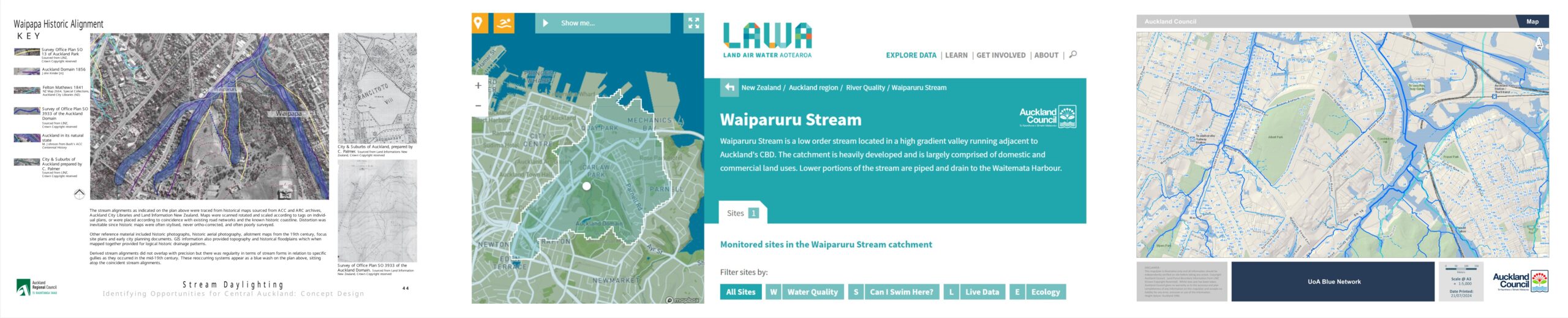
[Figure 2: Stream Mapping from ARC, LAWA and GeoMaps, taken from my Miro board]
So what?
I found the presentation really helpful for understanding how culturally informed projects can come to life. Honouring te Tiriti should be a foundational principle of any design, as well as community engagement where possible. In the absence of consultation and community engagement, the advice to us was to ensure that the key values of the design process are uplifting mana whenua, and being mindful of our ability as designers to create lasting impacts on communities.
My new understanding on the intricacies of classifying the stream path and limits to historic documentation will help explore the project with better clarity on historic considerations which can help me make more informed design choices.
Now what?
I felt more positive about moving forward with the project after the discussion on ethical community engagement, and now will endeavour to understand the community I am designing for within the constraints and limitations of the course by visiting the location again to observe community behaviours and stakeholders. Te Whainga phase of the Hautu Waka Design Methodology is about digging deeper, researching and exploring tohu. I will continue delving into different aspects of the project, such as learning more about how to design spaces that feel like spaces, and spatial considerations like pathways, signage and seating that make a space come to life. These learnings will help me achieve a well considered and highly functional end design product.
References:
Auckland Regional Council. (2008). Identifying opportunities for Central Auckland: Concept design (Technical Report TR2008/027). Auckland Regional Council. https://static1.squarespace.com/static/58e441d2f7e0abde3be51110/t/5d3f8da026916c000186191f/1564446136584/ARC+daylighting+project+and+info.pdf
Rolfe, G., Freshwater, D., Jasper, M. (2001). Critical reflection in nursing and the helping professions: a user’s guide. Basingstoke: Palgrave Macmillan.