
DEVELOP PHASE
DEVELOPING A SOLUTION TO A PROBLEM THAT 100 UNIVERSITY STUDENTS HAVE FOR #DES100
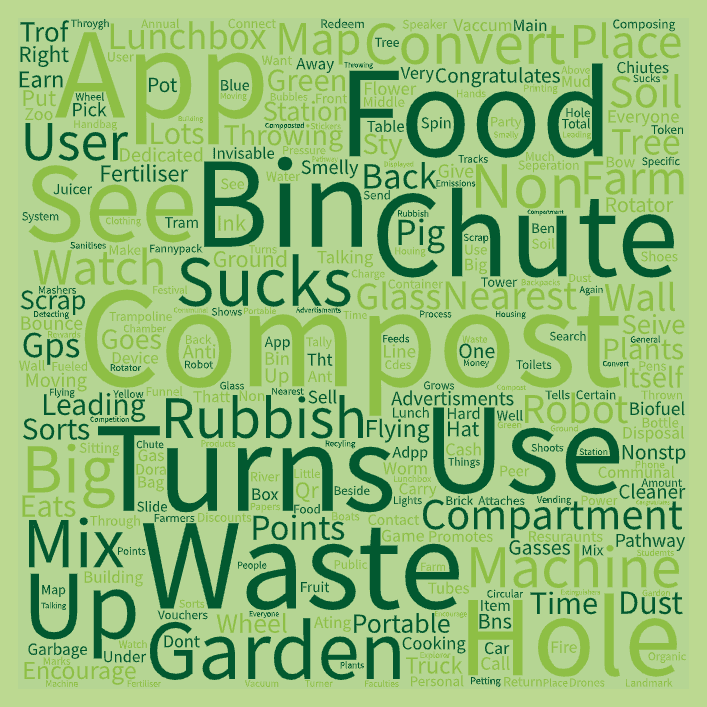
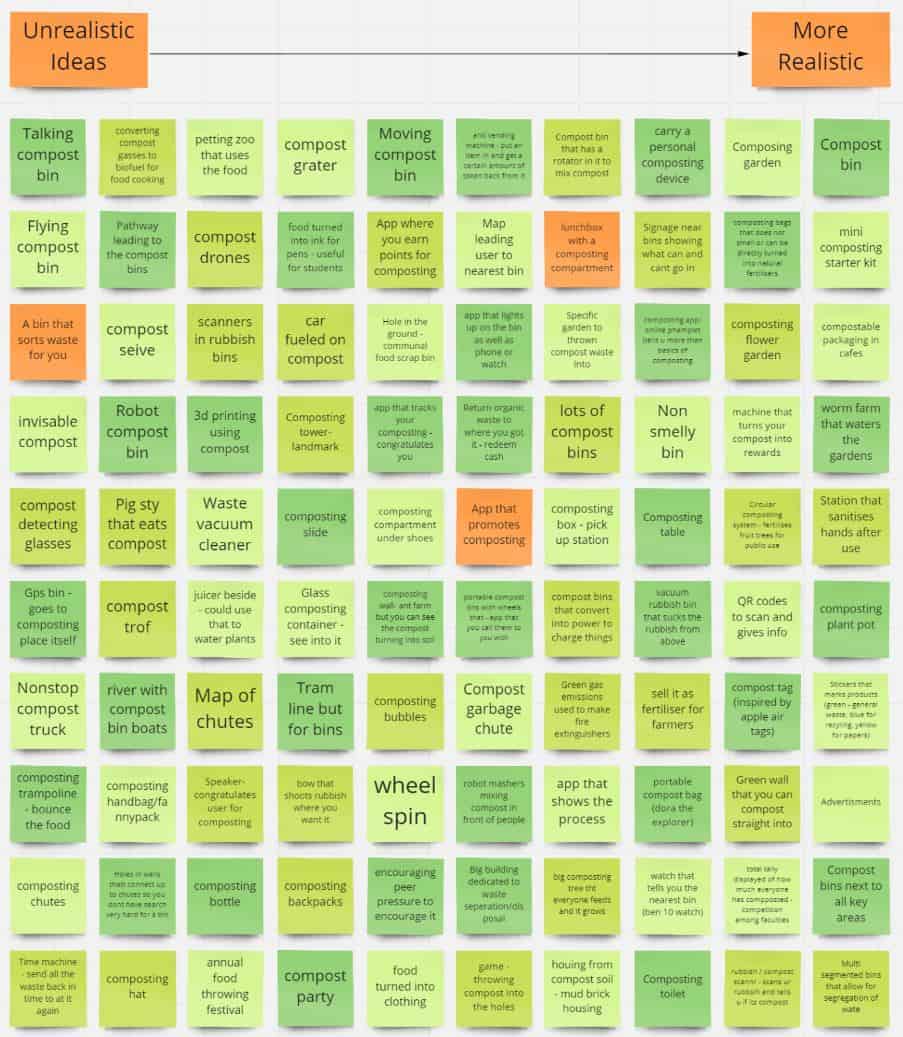
To start the development phase of this project, we brainstormed 100 ideas. At first they were quite practical, but the more we pushed ourselves to come up with, the more unique and out of the box they became. This was because we changed our environment several times, and brainstormed together so that we could bounce ideas and scenarios off of one another. We came up with a variety of concepts, and lots of variations of different ideas too.
I then categorised them in miro to make it more visually comprehensive. Three of our favourite ideas we got out of this exercise were:
- Talking bin that explains what to put in
- Lunchbox with a composting compartment
- An app where you earn points for composting
Our problem statement was that “as a university student, I want the ability to easily compost my organic waste so that I don’t have to go out of my way to be sustainable.” This lead to the how might we statement “How might we normalise the practice of separating organic waste from general waste so that university students have the opportunity to dispose of their waste sustainably.” In thinking up ideas that would be capable of answering this, it was useful to look back at the information and insights gained from the discovery phase.
From our research, we knew that standard composting bins placed around the university would work, as it is a common practice in other universities and public spaces that has been proven to work. This is why we decided to test some of our other ideas, to gain insight into other methods of encouraging students to segregate their waste sustainably.
Testing the ideas
A talking bin that explains what to put in it. When testing this idea, we completed two methods, one through a storyboard and one through being the prototype.
These testing methods worked well, as they gave a clear representation of the experience that a talking / smart bin could offer. It also gave us things to think about for if we decide to take this version further. Even when not considering the logistics of a bin like this, it is good to prototype the user experience, and see if it would be worth taking the idea further.

Another idea we tested was an app which shows the nearest bin, and can track your composting to earn points. Testing this idea was useful as it provided insight into the functionality of such an app. Some key considerations with this idea would be if students would be willing to use the app, if it would become obsolete after they learn where the bins are, and if it is actually solving the problem at hand.
We also tested the idea of a lunchbox with a composting compartment. This was especially good to test and see if it has any real value to the users. From testing, we found that most people that take lunchboxes to university already – or that would be willing to – just put their organic waste back in their lunchbox to take home. The composting compartment was seen as a waste of space because it would be empty for most of the day. If we decide to proceed with this idea, these insights will be valuable in ensuring that our final design is addressing the how might we statement, and adding value.

Reflection
The develop phase was beneficial because it showed us a lot of insight into each of the three ideas, provided a chance for us to visualise and test ideas ourselves, as well as get feedback from others about it. Although none of the ideas will be our final product, it is good to look at the problem from different perspectives. Simply testing the practicality of each idea is enough to help develop further insight. Having a portable/personal composting option is a solution that I think could be quite useful, and I am excited to see where the idea leads us, after we test and prototype further.