
DEFINE PHASE
DEFINING A PROBLEM THAT 100 UNIVERSITY STUDENTS HAVE FOR #DES100

To begin we brainstormed patters, surprises and tensions that we had see throughout the discovery phase. We also looked at the types of people we met along the way, thought about what we were interested to learn, and what differences could be made. This process was useful as it highlighted key areas of improvement. From this, we could then form problem statements that define what our team has found to be the main issues. One of these was, As a university student, I want the ability to easily compost my organic waste so that I don’t have to go out of my way to be sustainable. From this, we could then construct the how might we statement with more clarity.
How Might We Statement
After coming up with a variety of problem statements to choose from, I came up with lots of how might we statements. These included:
- How might we provide a service that facilitates students ability to easily compost their organic waste so that it does not end up in landfill.
- How might we provide a service that ensures students have the opportunity to compost so that they can reduce their environmental footprint.
- How might we provide a service that ensures students have the opportunity to easily compost so that they don’t have to go out of their way to be sustainable.
After this, we came up with one statement as a group, which fused all of our ideas together into one cohesive statement.
How might we normalise the practice of separating organic waste from general waste so that university students have the opportunity to dispose of their waste sustainably.
Our group chose this specific problem because in our discovery phase, we found that the practice of disposing of organic waste into the landfill had become normalised. We see this a an issue, as it contributes unnecessarily to greenhouse gas emissions. Not having compost bins available around the campus is decreasing both the opportunity and likelihood that students will compost. We aim to fix this problem through our project.
Customer Experience Journey Audits

We looked at each of the steps taken during the process of throwing waste out on campus, as it currently is. Looking at the negative experience areas of the process will help to see which parts of the experience our design needs to fix.
Disposing of rubbish is a mundane process, and often doesn’t get a lot of thought put into it. On average it is a neutral experience, and to improve this we would need to change it to a positive one. The most negative parts of the chain are when the user is analysing the disposal options, attempting to avoid contact with the bin, and guilt over not composting. By changing these to be a better experience we can elevate the whole process.
Insights
It was interesting to actually write out all of the steps, because its not really a process that we put a lot of thought into, but still has many intracate steps that we go through in order to dispose of wase. Each of these steps has positive and negative aspects to it, that when going about our day to day lives we normally don’t consider. It made me realise that the process of putting something in a bin could also be changed, not just the system used to seperate of types of waste.
Stakeholders Mapping
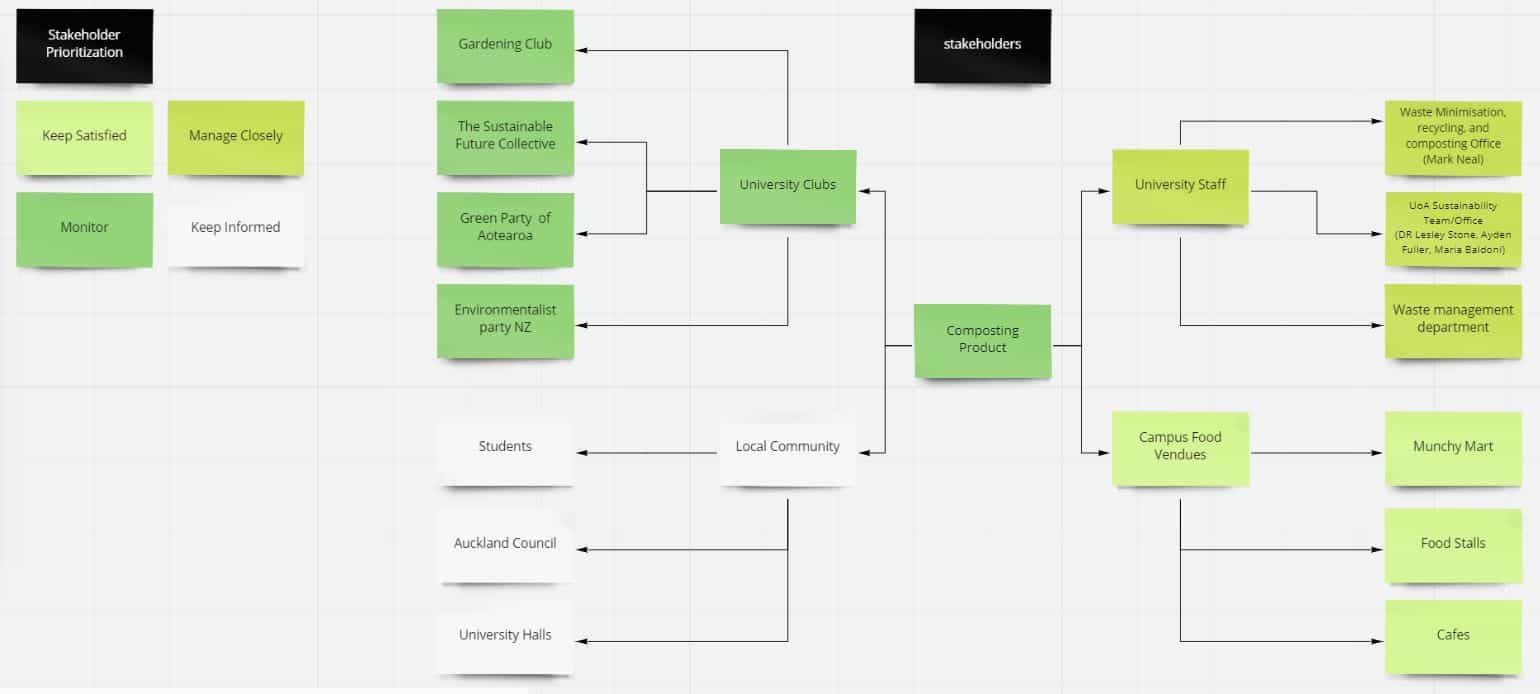
We also started a map of all the different stakeholders/people that would be affected by the project. From our definition of stakeholders, we found that there is a recycling and composting manager at the university, so I emailed to enquire about current or future plans for composting around the university. I also ranked each of the key groups of stakeholders, prioritising them from who would be most important to manage closely, keep satisfied, monitor and keep informed.
Observations
This would be helpful if we were going to end up implementing our product, as it indicates who else would need to be consulted throughout the process. The core, supportive, involved and periphery stakeholders are good to define, so that design considerations relating to each of those groups can also be ranked in corresponding importance.